
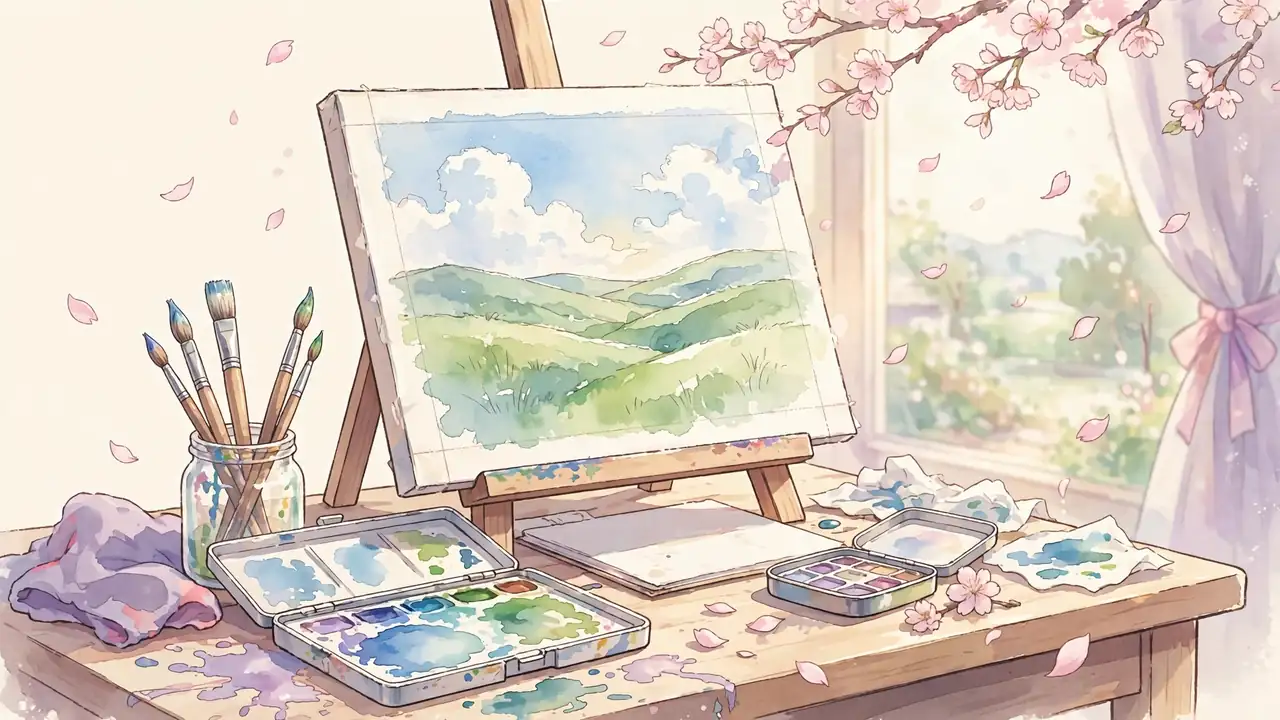
Studio Ghibli Art: The Hand-Painted Magic Behind the Films
Studio Ghibli art explained: the hand-painted style, Kazuo Oga's backgrounds, the signature palette, and how to paint Ghibli-style scenes yourself.
You can pause almost any Ghibli film at a random second and frame the shot. That doesn’t happen by accident. Studio Ghibli art is the product of painters who treated every background like a standalone painting, and this guide breaks down the style, the artists, and how you can learn to paint it yourself.
What Makes Studio Ghibli Art Instantly Recognizable?
Show a single frame to anyone who has seen three Ghibli films and they’ll name the studio before the movie. The giveaway is the light. Studio Ghibli art paints sunlight the way you remember it, not the way a camera records it: dappled through leaves, pooling on wooden floors, turning an ordinary kitchen golden at 5pm.
Then there’s the detail density. A Ghibli background doesn’t blur the world behind the characters. It paints every roof tile, every blade of grass, every cloud with the patience of someone who genuinely loves looking at things. The style sits between realism and dream, close enough to real life that you feel you could walk into it, soft enough that you know you can’t.
The Studio Ghibli Art Style: Hand-Painted From Start to Finish
The Studio Ghibli art style is, at its core, a watercolor and gouache tradition. Backgrounds were painted by hand on paper, giving them soft color bleeding, visible brush texture, and gradients that digital fills still struggle to imitate. Even as the industry moved to digital, Miyazaki famously shut down the studio’s computer-graphics department before Ponyo to keep working in hand-drawn images, allowing only small CGI touches.
The broader Studio Ghibli style has a few rules you can spot in every film:
- Soft, nature-derived palettes. Warm pastels, muted greens and blues, gentle yellows. Neon and hyper-saturation are nowhere to be found.
- Atmosphere over accuracy. Skies get the most love of any element. Cumulus clouds pile up like sculptures, sunsets bleed from amber to dusty purple, and weather is practically a character.
- Lived-in spaces. Architecture has moss between roof tiles, rust on rivets, laundry on lines. Nothing looks freshly built, and that’s the point.
- Tiny signs of life. Wind moving grass, petals drifting, dust motes in sunbeams. The scenes feel alive because something small is always moving.
Kazuo Oga: The Studio Ghibli Artist Behind the Backgrounds
Every Studio Ghibli artist contributed to the look, but one name belongs on every fan’s radar: Kazuo Oga, the background art director whose gouache paintings defined the scenery of My Neighbor Totoro, Princess Mononoke, Spirited Away, and more. His forests have a depth you can fall into, built from layered washes of green that shift from sunlit yellow-green to deep shadow teal.
Oga worked in poster color (opaque gouache), which explains the look fans always try to describe: it reads like watercolor in its softness, but the colors are rich and clean, never muddy. Searches for studio ghibli backgrounds usually mean one of two things: the original painted film backgrounds themselves, or wallpapers made from them. Either way, Oga’s work is the reason the phrase exists. And above him sat Hayao Miyazaki himself, who drew thousands of layout sketches and watercolor concept paintings to lock the mood of every scene before the background team touched it. When people say Ghibli backgrounds feel directed, that’s why. They were.
Studio Ghibli Landscapes: Skies, Forests, and Seas
If the characters are the heart of Ghibli, the landscapes are the lungs. The studio returns to the same natural subjects again and again, and each film finds a new way to paint them.
Skies get top billing. The famous Ghibli cloud is a towering cumulus with a flat glowing base and sculptural top, painted so you can feel the altitude. Dawn skies run pale lavender to cerulean; golden hour runs amber to coral; storm skies go a bruised, beautiful grey-blue.
Forests are painted as cathedrals. Light filters through canopy in visible shafts, moss covers everything it can reach, and the greens layer from bright new-leaf yellow down to near-black shadow. The forest in Princess Mononoke and the camphor tree in Totoro are the twin peaks of this obsession.
Seas and rivers shimmer rather than sparkle. Ponyo’s ocean is all rolling stylized waves, while the river in Spirited Away glows like it’s lit from underneath. Water in Ghibli is always in motion, even in a still frame.
The Famous Studio Ghibli Houses
Nobody paints a house like Ghibli. The studio’s buildings are characters with addresses: the Kusakabe house in Totoro with its dark, creaky rooms and soot sprites in the corners; the bakery attic where Kiki sleeps; the bathhouse in Spirited Away, a towering wooden palace of lanterns and steam; Howl’s castle, a walking junkyard held together by magic and Calcifer’s mood.
What unites the famous Studio Ghibli houses is clutter with love. Shelves hold jars and books you’ll never read. Kitchens have steam rising from pots. Every room looks used, which is exactly why fans want to live in them. The houses sell the fantasy better than any dragon does: the magic is in the mortar.
How to Paint Studio Ghibli-Style Art Yourself
You don’t need the studio’s budget, just patience and the right approach. Here’s a practical path that actually works:
1. Pick the right medium. Watercolor or gouache. Watercolor gives you the soft bleeds; gouache gives you the opaque, clean color of the real backgrounds. Start with a small travel set so you actually finish pieces.
2. Steal like a background artist: use reference. Oga painted from real forests. Photograph or sketch a real sky, a real tree line, a real street. Ghibli’s fantasy is built on observed reality.
3. Block big shapes first. Sky, distant hills, mid-ground, foreground. Keep edges soft between sky and distance; sharpen them as you come forward. Atmospheric perspective, paler and bluer with distance, does half the work for you.
4. Keep the palette warm and restrained. Mix your greens from blue and yellow rather than using tube green straight. Push sunsets toward amber and coral, not red. Grey your shadows with blue instead of black.
5. Add the life last. The dappled light, the drifting petal, the laundry on the line. These small details are what make a study feel like a Ghibli frame.
6. Study one film per week. Pause Totoro for skies, Mononoke for forests, Spirited Away for architecture. Copy small sections as studies. Copying masters is how every painter learns.
The biggest beginner mistake is over-detailing too early. Ghibli backgrounds look intricate, but they’re built from simple shapes with patient layering. Get the big sky gradient right before you paint a single leaf. And work small: a postcard-sized study you finish teaches more than a poster-sized piece you abandon. Finish ten small skies and the eleventh will surprise you.
Ghibli-Style AI Art: What to Know Before You Generate
AI image tools can now imitate the watercolor look in seconds, and “Ghibli-style portrait” became one of the internet’s favorite prompts. If you’re generating for personal use, wallpapers, profile pictures, gifts, a few ground rules keep you on the right side of things.
Describe the technique, not the trademark: prompts like “soft watercolor washes, hand-painted background, golden hour light, lush meadow” get you the look. Asking for actual Ghibli characters or scenes by name is where it gets dicey, especially if you plan to sell or publish the result. And remember that a generated image is a starting point: the pieces that feel most Ghibli are the ones where a human adjusts the light, the composition, and the small living details afterward.
Want structured help writing those prompts? Our Ghibli prompt builder walks you through building detailed art prompts.
Studio Ghibli Art Books Worth Owning
If one shelf could teach the style, it would hold the “Art of” series. Each volume reproduces backgrounds, concept paintings, and storyboards at a size where you can actually study the brushwork. Start with The Art of Spirited Away for architecture, The Art of Princess Mononoke for forests, and The Art of My Neighbor Totoro for skies. Miyazaki’s watercolor storyboard collections are the advanced course: rough, energetic, and full of the decisions that never made it to screen. Buy used if the new prices sting; the paintings don’t care.
For digital study, pause the films themselves. Pick a favorite scene, screenshot it, and color-pick the palette in any art app. You’ll find the same five or six hues doing all the work: a sky blue, a meadow green, a warm cream, a sunset coral, a shadow teal. Learning to see those five colors is half the battle.
Where to See Real Ghibli Art: Books and Exhibits
The best way to study the style is the source material. The “Art of” book series, The Art of Spirited Away, The Art of Princess Mononoke, The Art of Howl’s Moving Castle, and the rest, reproduce backgrounds, concept paintings, and Miyazaki’s watercolor storyboards at full size. They’re the closest thing to standing in the studio.
For the in-person experience, traveling exhibitions display original production art. The Academy Museum’s exhibition on Ponyo celebrated the film’s traditional hand-drawn animation with original artwork on the walls. Exhibition lineups rotate, so check museum schedules in your city, and if you’re already planning a trip around Studio Ghibli Fest 2026, see whether an exhibit is running nearby that week.
Using Ghibli-Inspired Art for Wallpapers and PFPs
The style makes perfect profile pictures and wallpapers because it reads beautifully at any size. A single painted cloud, a lantern-lit street, a meadow at golden hour: all of them crop down to a circle without losing their mood. If you’re hunting for avatar ideas, our anime PFP ideas hub has original concept cards, and fans of the films themselves can browse the best Studio Ghibli movies, meet the Studio Ghibli characters, or test yourself with an anime quiz. Pair a Ghibli-style wallpaper with a rewatch of the films, and don’t miss the art books in our Studio Ghibli merch guide.
Frequently Asked Questions
What is Studio Ghibli art known for?
Studio Ghibli art is known for hand-painted watercolor and gouache backgrounds, soft natural color palettes, incredibly detailed skies and landscapes, and lived-in architecture. Every frame looks like a painting because the backgrounds genuinely were painted by hand.
Who painted the famous Ghibli backgrounds?
Kazuo Oga was the studio’s legendary background art director, painting the lush scenery for films like My Neighbor Totoro, Princess Mononoke, and Spirited Away with gouache. Hayao Miyazaki himself drew thousands of layout sketches and watercolor concept paintings.
Can I learn to paint in the Studio Ghibli art style?
Yes. Start with watercolor or gouache, study real landscapes for reference, keep colors soft and natural, and practice skies and foliage. The guide on this page walks through the process step by step.
What colors define the Ghibli palette?
Soft sky blues, meadow greens, warm creams, sunset corals, and golden-hour ambers. The palette stays warm and slightly desaturated, avoiding neon or hyper-saturated tones.
Is AI-generated Ghibli-style art okay to use?
For personal wallpapers and profile pictures it’s a gray area most fans accept, but selling Ghibli-style art or claiming it’s official crosses a line. Always check the terms of the tool you use.
Where can I see real Ghibli artwork in person?
Traveling exhibitions like the Academy Museum’s Ponyo show display original production art. Art books such as The Art of Spirited Away and The Art of Princess Mononoke collect backgrounds and concept paintings.
Why does Ghibli art feel nostalgic even to first-time viewers?
The paintings capture universal memories: summer clouds, rain on windows, sunlit kitchens. The detail triggers a sense of place you’ve felt before, even if you’ve never seen the film.