How to Make a Balanced MHA OC Quirk (Step by Step)
Updated: 8 November 2026
The fastest way to spot a weak My Hero Academia OC is a Quirk with no cost. In the series, every power comes with a price, and that price is what makes fights tense and characters grow. A balanced Quirk isn’t a weaker Quirk. It’s one with rules.
This guide walks you through building an original Quirk in five steps, with real examples from the series, a balance checklist, and a free OC sheet you can copy.

What makes an MHA Quirk “balanced”?
A balanced Quirk has a clear ability, clear limits and a cost that matters in a fight. If your character can solve every problem with their power and never pays for it, the Quirk is unbalanced. In My Hero Academia, even the strongest heroes have weaknesses, which is why their battles are worth watching.
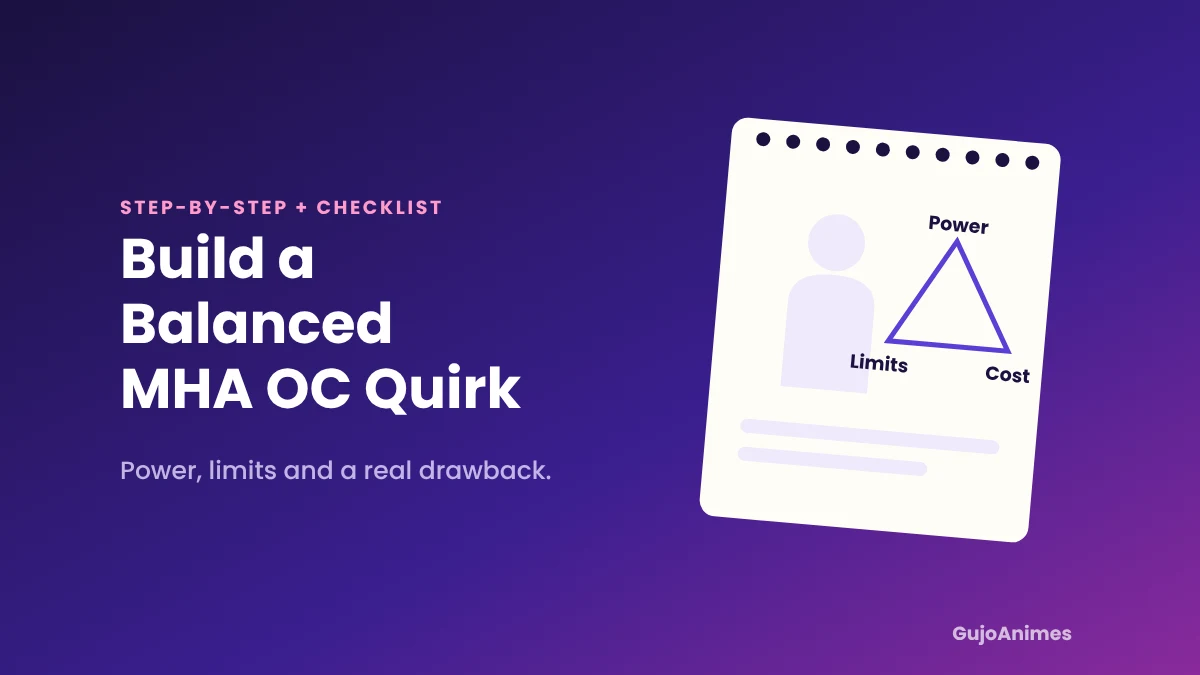
Think of it as a triangle: power, limits and drawback. Raise one, and the other two should rise with it.
Step 1: Pick a Quirk type
Start by choosing whether your Quirk is an Emitter, a Transformation or a Mutant. The type decides how it works day to day.
- Emitter: creates or controls something outside the body. Good for ranged and support roles.
- Transformation: changes the body for a short time. Good for tanks and brawlers.
- Mutant: a permanent body change. Good for strong visual designs and backstories with built-in conflict.
Not sure which fits? Our guide to MHA Quirk types explains all three, plus hybrids.
Step 2: Define the core ability in one sentence
Write the Quirk in one plain sentence. If you need three sentences, it’s probably doing too much.
- Weak: “She controls water, ice, steam, weather and can breathe underwater.”
- Strong: “She can turn any liquid she touches into ice.”
The best Quirks in the series are simple ideas used cleverly. Ochaco Uraraka’s Zero Gravity just removes gravity from what she touches, and the story finds dozens of uses for it.
Step 3: Add a drawback that hurts
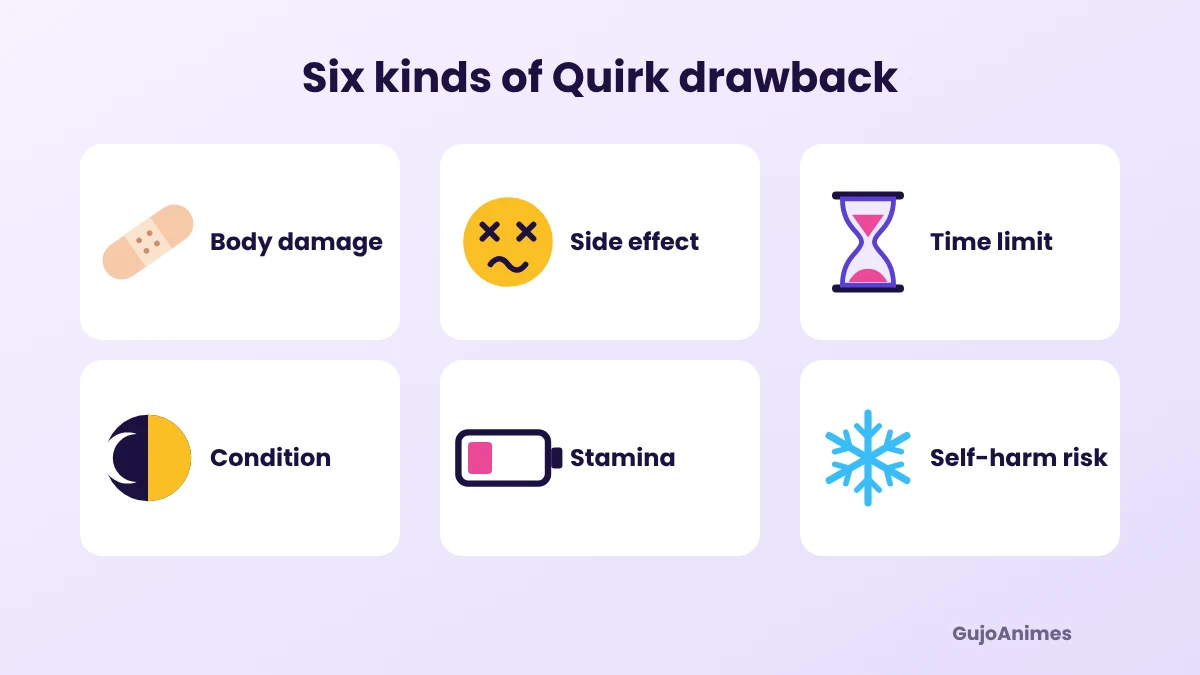
This is the step most OCs skip. A good drawback should show up in combat, not just in a backstory. Here are the six kinds of drawbacks the series uses, with canon examples:
| Drawback type | How it works | Canon example |
|---|---|---|
| Body damage | Using too much power injures the user | Izuku Midoriya breaking his bones with One For All early on |
| Side effect | Overuse causes sickness or a mental cost | Ochaco Uraraka’s nausea, Denki Kaminari short-circuiting his brain |
| Time limit | The power only lasts so long | All Might’s shrinking daily time limit after his injury |
| Condition | The power depends on the environment | Fumikage Tokoyami’s Dark Shadow: weak in light, hard to control in darkness |
| Stamina | Holding the power wears the user down | Eijiro Kirishima’s Hardening cracking over time |
| Self-harm risk | The power can turn on the user | Shoto Todoroki’s ice building frost on his own body |
Pick one main drawback, and maybe a smaller second one. Two strong drawbacks can make a powerful Quirk feel fair.
Step 4: Set the limits
Limits are different from drawbacks. A drawback is what using the Quirk costs; a limit is what the Quirk simply can’t do. Decide these four:
- Range: touch only, a few metres, or line of sight?
- Duration: an instant, a few minutes, or until they stop?
- Trigger: what activates it? Touch, sound, eye contact, a body part?
- Capacity: how much can it affect? One object, one person, a whole room?
Uraraka is a good model. Her Quirk needs her fingertip pads to touch the target, and she can only float so much total weight before she gets sick. Those two limits shape every fight she’s in.
Step 5: Add a hero name, costume and support gear
In My Hero Academia, a hero’s name and costume usually grow out of their Quirk.
- Hero name: most mix the Quirk with wordplay. Uraraka becomes Uravity (Uraraka + gravity), and Tsuyu Asui becomes Froppy. Short, sayable, and linked to the power. Stuck? Try our hero name generator.
- Costume: design it to cover a weakness or boost a strength. Katsuki Bakugo’s grenade-shaped gauntlets store his explosive sweat so he can fire bigger blasts without hurting his arms.
- Support items: U.A.’s Support Course, home of inventor Mei Hatsume, builds gear that patches a Quirk’s limits. Giving your OC one item that fixes a weakness is a very canon touch.
Which Quirks do RP servers usually ban?
Many MHA roleplay communities keep lists of banned or limited Quirks, because some powers break a shared story. If you’re making an OC for RP, avoid these unless your server allows them:
- Time manipulation (stopping, rewinding or skipping time)
- Reality warping (changing the rules of the world)
- Quirk copying or stealing without strict limits
- Mind control with no counter
- Instant healing or immortality
- Several unrelated Quirks in one character
Even outside RP, these are hard to write well. If you use one, pile on limits and a heavy drawback.
The 5-question balance checklist
Run your Quirk through these before you call it finished:
- ☐ Can you explain the Quirk in one sentence?
- ☐ Does it have at least one drawback that would matter mid-fight?
- ☐ Is there a clear limit on range, duration or capacity?
- ☐ Could a canon character beat your OC with smart tactics?
- ☐ Does the Quirk give your character a problem to grow through?
If you answered “no” to two or more, go back to Steps 3 and 4. A Quirk that passes all five will feel like it belongs in the series.
Free MHA OC sheet template
Copy this template into your notes, doc or RP server:
Name:
Hero / villain name:
Age & school year:
Quirk name:
Quirk type: Emitter / Transformation / Mutant / Hybrid
Ability (one sentence):
Main drawback:
Second drawback (optional):
Range / duration / trigger / capacity:
Costume & support item:
Ultimate move:
Personality in three words:
What the Quirk costs them emotionally:
Get a starting idea in one click
If you’re stuck at Step 1, let our MHA Quirk Generator give you a random Quirk with a name, type and weakness. Then run it through Steps 2–5 to make it truly yours.
Frequently asked questions
How do I make my MHA OC’s Quirk not overpowered?
Give it one clear ability, strict limits on range or duration, and a drawback that shows up in combat.
Can my OC have two Quirks?
It’s very rare in canon. Only special cases like One For All, All For One or artificially modified characters have more than one. A single, well-designed Quirk usually works better.
What are good Quirk drawbacks?
Body damage, side effects like nausea, time limits, environmental conditions, stamina drain, or the power hurting the user.
Should my OC’s Quirk come from their parents?
It helps. Quirks in the series are often inherited, so a parent’s power is an easy way to build a backstory.
What’s the difference between a Quirk limit and a drawback?
A limit is what the Quirk can’t do. A drawback is what using it costs the user.
Learn the full rules of the power system in our complete guide to My Hero Academia Quirks.
GujoAnimes is an independent fan site and isn’t affiliated with Kohei Horikoshi, Shueisha or Studio Bones.
Sources: MHA Fandom wiki (character Quirk pages) · Sportskeeda, “How Quirks function” · MHA roleplay “Banned and Limited Quirks” list (HackMD) · GujoAnimes Search Console data (OC-related queries)