
My Hero Academia Quirks: The Complete Guide
Updated: 8 November 2026
In My Hero Academia, almost everyone is born with a superpower. The series calls it a Quirk, and it shapes everything: who becomes a hero, who gets pushed aside, and who turns to villainy. This guide explains how Quirks work, where they came from, and what changed after the story ended.
If you’d rather make one than read about them, our MHA Quirk Generator creates a random Quirk with a name, type and weakness in one click.

What is a Quirk in My Hero Academia?
A Quirk is a superhuman ability a person is born with in Kohei Horikoshi’s My Hero Academia (Boku no Hero Academia, or BNHA). It works like a physical trait, the same way eye colour or height does. Around 80% of people in the series have one, so having powers is normal and being without one is the exception.
Early in the story, Quirks are also called “meta abilities”. Both terms mean the same thing.
Where did Quirks come from?
The series traces the first Quirk to a newborn baby in Qing Qing City, China, who was born glowing with light. After that, superpowers started appearing around the world. Over the next generations, society rebuilt itself around them, with laws, licences and a new profession: the Pro Hero.
Nobody in the story fully explains why Quirks appeared. That mystery is part of what keeps the setting interesting.
How do Quirks work?
Every Quirk follows the rules of the user’s body. That’s the key idea behind the whole power system.
- It’s biological. A Quirk comes from a “Quirk Factor” in the body. For Ochaco Uraraka, the pads on her fingertips are the part that activates her Zero Gravity Quirk.
- It has limits. Use it too much and the body pays. Uraraka gets nauseous when she floats too much weight. Denki Kaminari short-circuits his brain if he releases too much electricity.
- It can be trained. Practice raises a Quirk’s power, control and range. That’s why U.A. High School’s Hero Course exists.
- It’s often inherited. Children usually get a Quirk linked to one or both parents. Shoto Todoroki’s Half-Cold Half-Hot comes from his mother’s ice and his father Endeavor’s fire.
These rules matter if you’re building your own character. Our guide on how to make a balanced MHA OC Quirk turns them into a step-by-step method.
When do Quirks appear?
Most Quirks show up by around age four. If nothing has appeared by then, a doctor checks the child’s feet. Quirkless people have an extra joint in their pinky toe, a trait the series links to having no Quirk.
That’s exactly what happens to Izuku Midoriya in Chapter 1. A doctor sees the extra joint and tells his mother he will never develop a Quirk, which sets up the whole story.
What are the 3 types of Quirks?
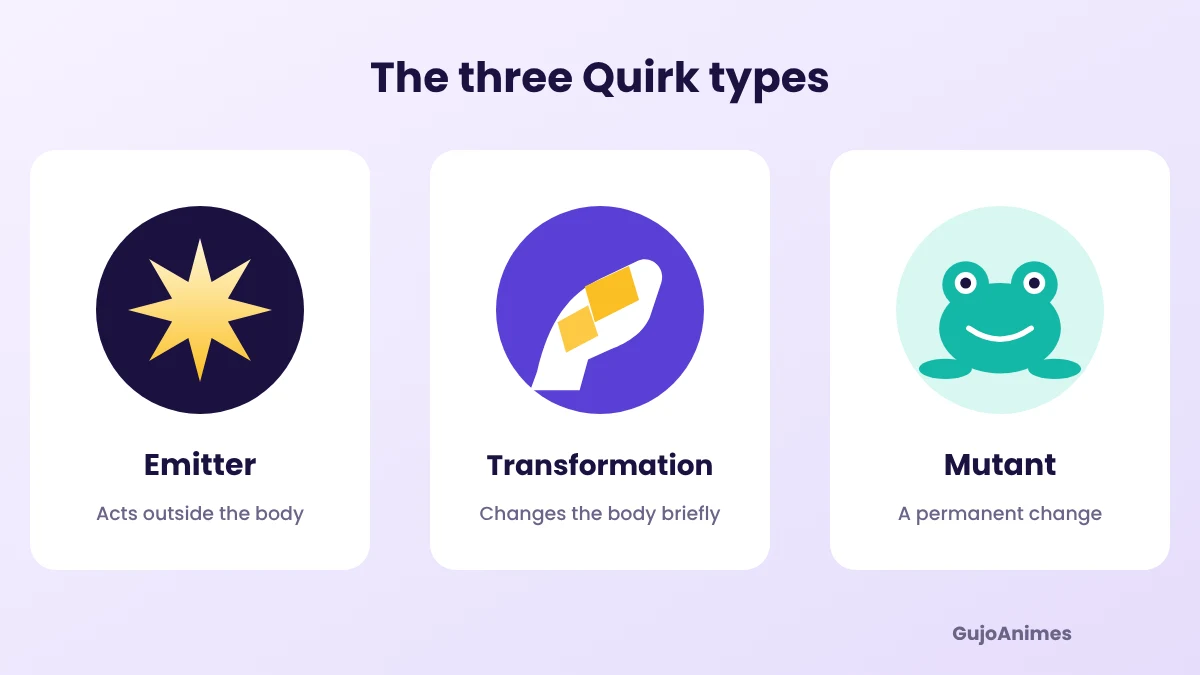
Quirks are grouped into three main types:
| Type | What it does | Example |
|---|---|---|
| Emitter | Creates or controls something outside the body | Katsuki Bakugo’s Explosion |
| Transformation | Changes the body for a short time | Eijiro Kirishima’s Hardening |
| Mutant | A permanent change to the body | Tsuyu Asui’s Frog |
The lines aren’t always clean, and fans argue about extra categories like Accumulation. We break it all down, with every Class 1-A student classified, in our guide to MHA Quirk types.
Can Quirks be transferred, stolen or erased?
Normally, no. A Quirk belongs to one person for life. The story’s biggest conflicts come from the rare exceptions:
- One For All can be passed on. All Might gives it to Deku by having him swallow a strand of his hair, which carries the Quirk’s DNA.
- All For One can steal Quirks and give them to others. Its user is the series’ central villain.
- Erasure, Shota Aizawa’s (Eraser Head’s) Quirk, switches off another person’s Quirk while he looks at them.
- Quirk drugs change Quirks artificially. “Trigger” boosts them, while Overhaul’s bullets, made from the girl Eri’s Rewind Quirk, can destroy them.
What are the rules for using Quirks?
In hero society, using a Quirk in public is tightly controlled. Only licensed Pro Heroes can use them freely to fight crime or save people. Students need a Provisional Hero License before they can act in real emergencies. The Hero Public Safety Commission oversees the system.
People who use Quirks illegally to fight crime are called vigilantes. That grey area is the focus of the spin-off My Hero Academia: Vigilantes.
What is Quirk awakening?
A Quirk awakening is a sudden leap in power, usually triggered by extreme stress. Very few characters reach it in the series. Tomura Shigaraki’s Decay and Himiko Toga’s Transform both awaken at key moments, and both become far more dangerous. Full guide coming soon in our Quirk awakening explainer.
What is the Quirk Singularity theory?
The Quirk Singularity is an in-universe theory from Dr. Kyudai Garaki. It says Quirks grow stronger and harder to control with each generation, until one day they can’t be controlled at all. The series raises it as a looming threat, but never fully pays it off. We’ll cover what the ending means for it in a dedicated post.
Quirks after the final war
The manga ended in August 2024, and the anime finished its final season in late 2025, followed by the bonus episode My Hero Academia: More. The epilogue jumps eight years ahead to show the next generation of heroes.
The series’ 10th anniversary is running now, with a concert in November and a Jump Festa stage on 19 December. See our MHA 10th anniversary guide for every date.
Create your own Quirk
Now that you know the rules, try them out:
- Generate one instantly with our MHA Quirk Generator
- Build it properly with our balanced OC Quirk guide
- Give your hero a name with our hero name generator
Frequently asked questions
What is a Quirk in My Hero Academia?
A Quirk is a superpower a person is born with. About 80% of people in the series have one.
How many types of Quirks are there?
Three main types: Emitter, Transformation and Mutant.
At what age do Quirks appear?
Usually by around age four. Children with no Quirk by then are checked for an extra pinky toe joint.
Can a Quirk be given to someone else?
Only in rare cases. One For All can be passed on, and All For One can steal and give Quirks.
Who has the strongest Quirk in MHA?
It depends on the arc, but One For All and All For One are the two most powerful Quirks in the story.
Want to see the heroes in action? Start with the main anime and the spin-off My Hero Academia: Vigilantes.
GujoAnimes is an independent fan site and isn’t affiliated with Kohei Horikoshi, Shueisha or Studio Bones.
Sources: Wikipedia: My Hero Academia · Sportskeeda, “How Quirks function” · AnimeHunch, “Quirk Factor explained” · FandomWire, Quirk Singularity coverage · ComicBook.com (series ending, box set)

