Free tool · No sign-up
Japanese Last Names and Meanings: The 20 Most Common Surnames Explained
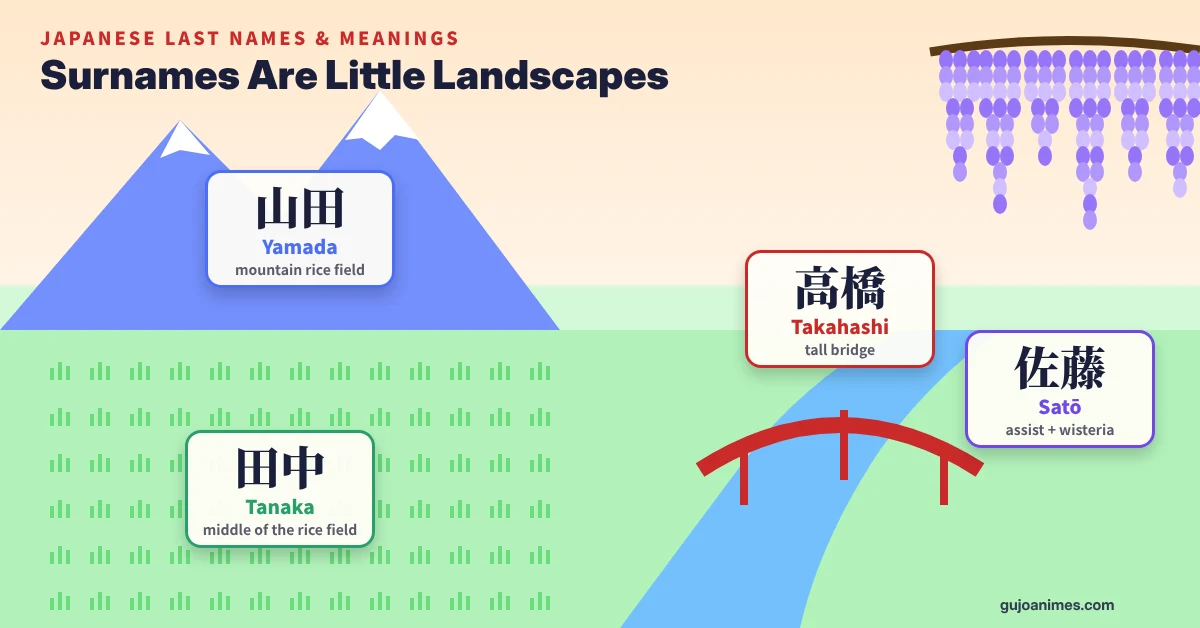
Most Japanese last names are tiny descriptions of a place: a rice field, a mountain, a bridge, a river. This guide explains Japanese last names and meanings for the 20 most common surnames, how they came to be, and how to pick a surname for a character. For a full name, try the Japanese name generator.
Last updated: October 2026
Loading the generator…
Key takeaways
- The family name comes first in Japanese: in Tanaka Hiroshi, Tanaka is the surname.
- Satō, Suzuki and Takahashi are the three most common surnames.
- Most surnames describe landscape. Japan has an estimated 100,000+ different surnames.
- Married couples must share one surname by law, a rule under debate in 2026.
The 3 most common Japanese last names
| Rank | Surname | Kanji | Meaning | People (approx.) |
|---|---|---|---|---|
| 1 | Satō | 佐藤 | assist + wisteria | 2 million |
| 2 | Suzuki | 鈴木 | bell + tree | 1.75 million |
| 3 | Takahashi | 高橋 | tall bridge | 1.45 million |
Source: Nippon.com.
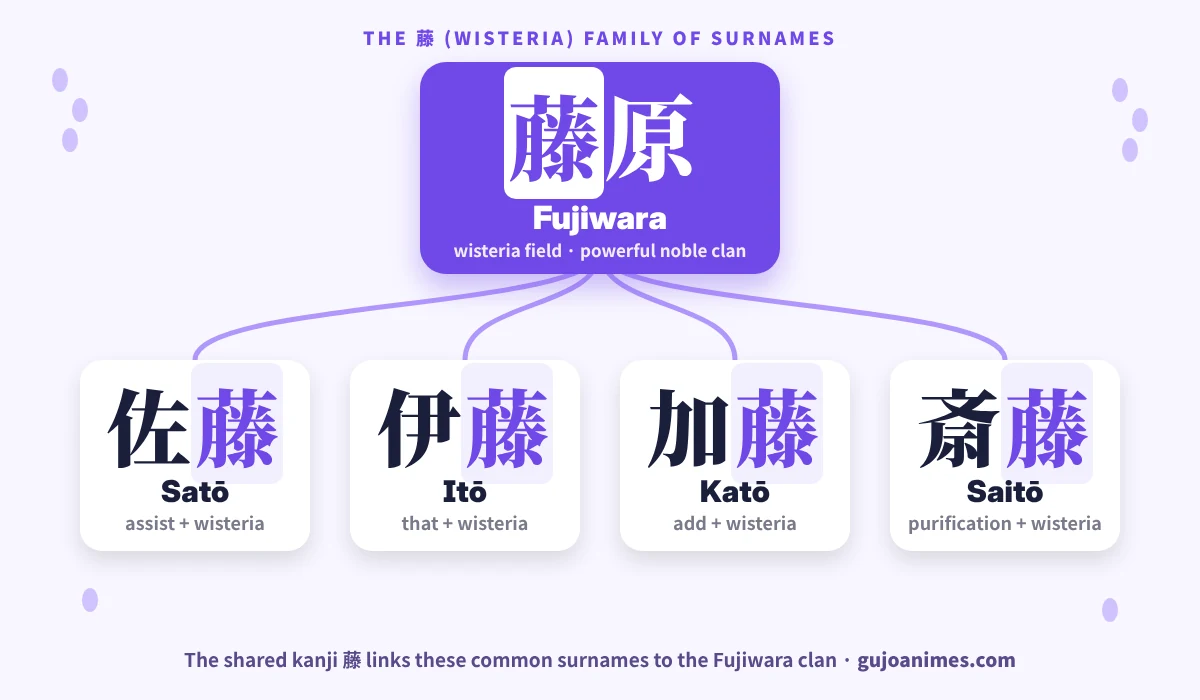
Satō is most common in Akita and Yamagata prefectures. Its 藤 (wisteria) is the same kanji as the “Fuji” in Fujiwara, the powerful noble clan; Itō, Katō and Saitō share that link. Suzuki likely comes from susuki, a word for a sacred ear of rice in the Kumano region of today’s Wakayama and Mie. Takahashi simply means “tall bridge” and may have been taken by families living near high bridges in mountain areas.
17 more common Japanese last names and their meanings
Rankings differ slightly by source, so these are listed without a rank.
| Surname | Kanji | Meaning |
|---|---|---|
| Tanaka | 田中 | middle of the rice field |
| Watanabe | 渡辺 | to cross + edge, area |
| Itō | 伊藤 | that + wisteria |
| Yamamoto | 山本 | base of the mountain |
| Nakamura | 中村 | middle village |
| Kobayashi | 小林 | small forest |
| Katō | 加藤 | add + wisteria |
| Yoshida | 吉田 | lucky rice field |
| Yamada | 山田 | mountain rice field |
| Sasaki | 佐々木 | assist + tree |
| Yamaguchi | 山口 | mountain entrance |
| Matsumoto | 松本 | base of the pine |
| Inoue | 井上 | above the well |
| Kimura | 木村 | tree village |
| Hayashi | 林 | forest |
| Saitō | 斎藤 | purification + wisteria |
| Shimizu | 清水 | pure water |
Why Japanese last names describe the landscape
Until the Meiji era, most ordinary people did not use an official surname. A law in 1875 required everyone to register one, so families often picked a name from what was around them: a field (田), a mountain (山), a village (村), a well (井), a tree (木). That is why the same kanji repeat across so many surnames, and why Japan ended up with so many different family names.
Common surname kanji and what they mean
| Kanji | Reading in names | Meaning | Example |
|---|---|---|---|
| 田 | ta / da | rice field | Tanaka, Yamada |
| 山 | yama | mountain | Yamamoto, Yamaguchi |
| 川 / 河 | kawa / gawa | river | Ishikawa, Kurokawa |
| 村 | mura | village | Nakamura, Kimura |
| 木 / 林 / 森 | ki / bayashi / mori | tree / grove / forest | Suzuki, Kobayashi, Morita |
| 井 | i | well | Inoue |
| 橋 | hashi / bashi | bridge | Takahashi |
| 野 | no | field, plain | Hoshino, Ono |
| 藤 | tō / fuji | wisteria | Satō, Fujita |
In the news: Japan’s surname rules in 2026
Updated October 2026
Under a law dating from the Meiji era, married couples in Japan must share one surname, and in more than 95% of cases the wife takes the husband’s name. The debate over allowing separate surnames has run for about 30 years. Prime Minister Sanae Takaichi’s government has favoured widening the legal use of birth names after marriage, rather than allowing couples to keep separate surnames. In May 2026 the government said it would not submit that bill during the current Diet session, and no new date had been announced as of October 2026.
Fun fact: a 2024 projection by Tohoku University economist Hiroshi Yoshida suggested that, if the single-surname rule never changes, everyone in Japan could be named Satō by the year 2531. It is a thought experiment, not a forecast.
Sources: The Japan Times, Jiji Press, Japan Today, Nippon.com, Wikipedia.
Anime last name generator with meaning
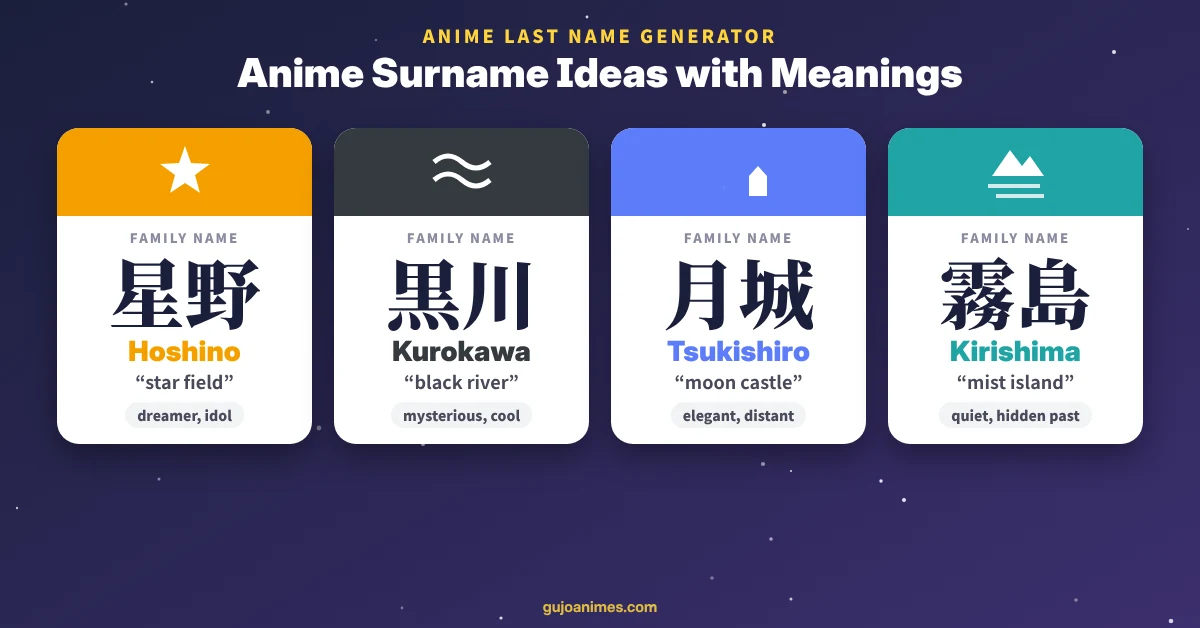
Anime writers often skip the most common surnames and pick rarer ones with a strong image, then pair them with an everyday given name. Our tool’s Anime mode works as a Japanese anime last name generator: it favours surnames like these, always with the meaning shown.
| Surname | Kanji | Meaning | Feels like |
|---|---|---|---|
| Hoshino | 星野 | star field | dreamer, idol |
| Kurokawa | 黒川 | black river | mysterious, cool |
| Tsukishiro | 月城 | moon castle | elegant, distant |
| Kirishima | 霧島 | mist island | quiet, hidden past |
| Shirogane | 白銀 | white silver | noble, rich |
| Akatsuki | 暁 | dawn | hopeful hero |
| Kagami | 鏡 | mirror | rival, double |
| Takamine | 高嶺 | high peak | out-of-reach, proud |
Need a Demon Slayer-style surname? Try the Demon Slayer last name generator. For full anime names, use the anime name generator.
Tips for choosing a Japanese surname
- For realism, pick a common one. A classmate called Tanaka or Suzuki feels natural.
- For a main character, go rarer but keep it pronounceable.
- Check the reading. The same kanji can be read differently; 山崎 can be Yamazaki or Yamasaki.
- Match the family’s story. A fishing family might have 浜 (beach) or 浦 (bay) in the name.